Physical Address
304 North Cardinal St.
Dorchester Center, MA 02124
Physical Address
304 North Cardinal St.
Dorchester Center, MA 02124

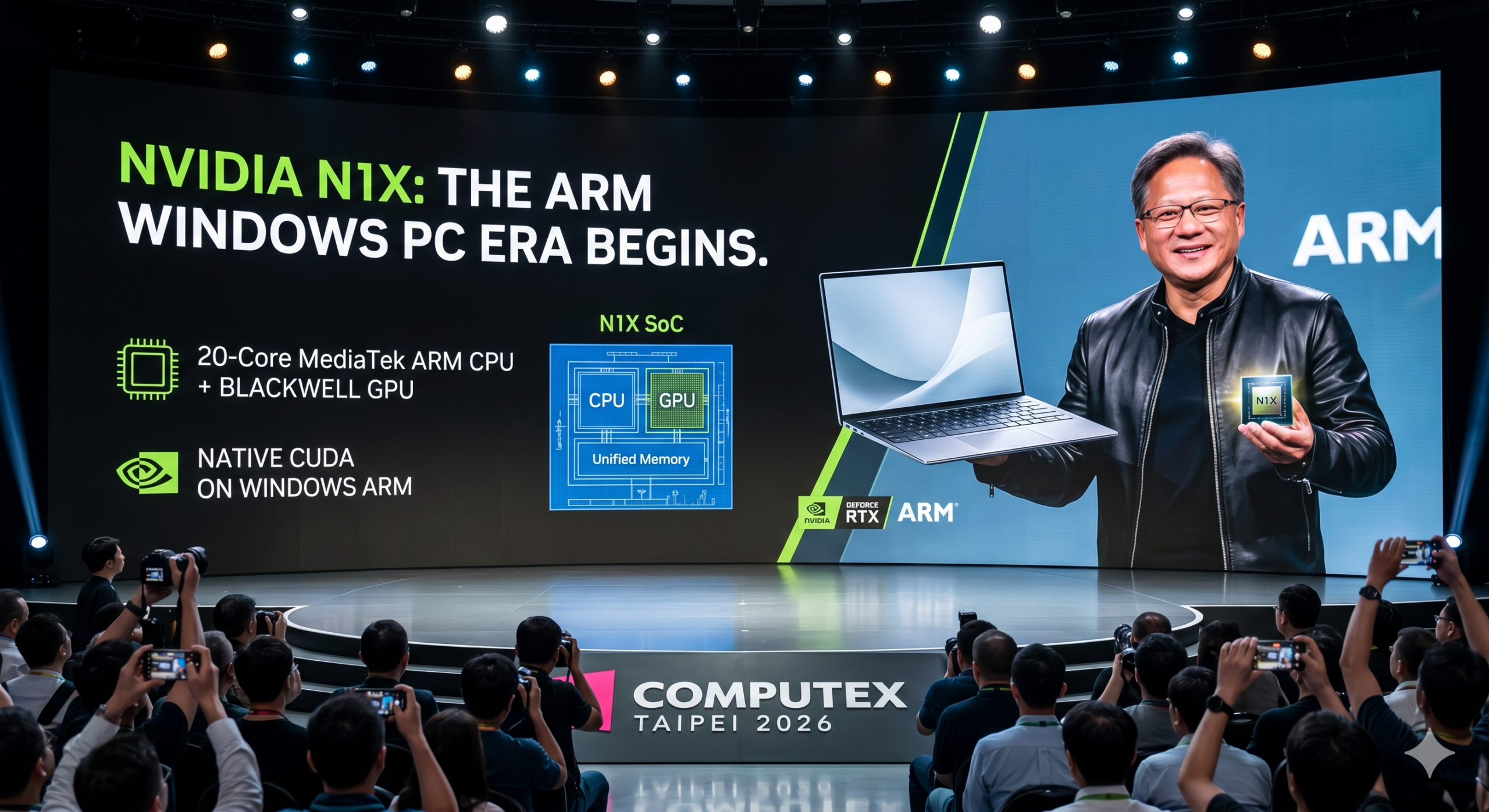
The consumer personal computer landscape is on the precipice of its most radical architectural shakeup since Apple migrated to its own M-series custom silicon. Over the weekend, a series of tightly coordinated, near-simultaneous social media teasers from the official Windows, Nvidia, and Arm accounts dropped a cryptic line that has sent shockwaves through the tech industry: “A New Era of PC.”
Accompanying the text were geographical coordinates—25.0528, 121.5990—pointing precisely to the Taipei Music Center, where Nvidia CEO Jensen Huang is scheduled to deliver his highly anticipated Computex opening keynote.
For over two years, whispers of Team Green building an ARM-based System-on-Chip (SoC) for mainstream consumer laptops have circled the supply chain. Today, the curtain has been entirely torn back. Massive hardware leaks, pre-release Geekbench entries, and embargoed OEM motherboard manifests have exposed the existence of the Nvidia N1X and its smaller sibling, the N1.
Nvidia is no longer content dominating data centers and discrete desktop graphics; they are mounting a direct, aggressive assault on the premium laptop territory long defended by Intel, AMD, and Qualcomm. Here is the comprehensive, deep-dive breakdown of the leaked specifications, performance targets, release timelines, and how the N1X platform plans to fundamentally rewrite the rules of Windows on Arm.
To understand what makes the N1X platform so disruptive, one must look at how the silicon is constructed. Rather than attempting to build a general-purpose CPU architecture from scratch, Nvidia partnered with mobile chip giant MediaTek to handle the core processing layout, allowing Nvidia to focus its engineering firepower on what it does best: massive parallel graphics processing and world-class artificial intelligence acceleration.
According to technical documentation sourced from leaked OEM evaluation boards and architectural presentations, the N1X is a unified, 2.5D multi-chiplet package manufactured on TSMC’s cutting-edge 3nm (N3) process node. The design is adapted directly from the high-end GB10 Grace Blackwell Superchip found inside Nvidia’s newly deployed DGX Spark mini-PC. By transposing this enterprise-grade hardware layout into a highly optimized laptop footprint, Nvidia has created an unprecedented category of consumer silicon.
The interconnect architecture between the MediaTek-designed Arm CPU complex and the Nvidia Blackwell GPU block relies on a proprietary ultra-fast bus capable of 300 GB/s bidirectional bandwidth. This incredibly wide pipe allows both processing units to share data instantly without the traditional bottlenecks associated with discrete PCIe lanes.
The leaked spec sheet for the flagship N1X highlights an incredibly dense computing block designed to challenge top-tier premium hardware.
The CPU side of the N1X does away with old-school cluster layouts, utilizing Arm’s newest v9.2 architecture. It features a robust 20-core configuration split evenly to manage heavy workflows and background tasks efficiently:
While a 20-core ARM processor is impressive, the absolute crown jewel of the N1X is its integrated graphics subsystem. The chip houses a full Blackwell-architecture GPU sporting 48 Streaming Multiprocessors (SMs), which translates to an astonishing 6,144 CUDA Cores.
To put that figure in perspective, 6,144 CUDA cores is the exact shader count found on the desktop Nvidia GeForce RTX 5070 graphics card. Never before has an integrated graphics processing unit (iGPU) packed this level of raw computational density. It includes:
Borrowing a page from Apple’s highly successful unified memory book, the N1X features a 256-bit memory interface tied to a massive pool of integrated LPDDR5X memory.
Early engineering boards have been spotted carrying a jaw-dropping 128GB unified memory layout, operating at a raw bandwidth of 273 GB/s. Because the CPU and GPU share the exact same physical memory pool, the GPU can access gargantuan datasets—such as texture maps or AI model weights—instantly, without having to mirror data across separate system RAM and VRAM partitions.
With hardware of this magnitude, the preliminary performance data leaking out of validation labs paints a highly competitive picture. Pre-release Geekbench prototype results demonstrate exactly where the N1X stands against the x86 old guard and the current ARM kingpins:
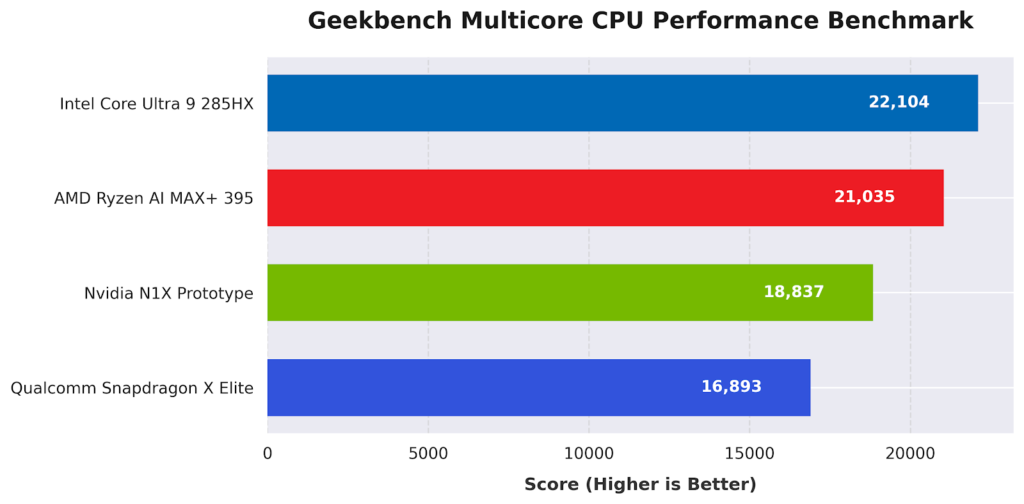
As shown above, the N1X brings immense processing power to the Windows on Arm landscape. Its single-core score lands at approximately 3,096, representing a clean 15% performance lead over Qualcomm’s Snapdragon X Elite platform.
In multi-threaded CPU workloads, the N1X punches out an impressive 18,837. While this trails monstrous x86 mobile workstations like the Intel Core Ultra 9 285HX or AMD’s high-end Ryzen AI MAX+ 395 by roughly 10% to 15%, those chips demand significantly higher power envelopes and live in thick, loudly-cooled gaming laptops. The N1X achieves these numbers inside a highly efficient SoC design.
Where Nvidia completely distances itself from every competitor on Earth is local AI computing. Because the N1X includes fifth-generation Tensor Cores supporting ultra-efficient FP4 math formats paired with a 128GB unified memory pool, it transforms standard laptops into mobile AI supercomputers.
Internal testing leaks indicate that the N1X can natively run and run inference on highly complex, quantized large language models—including Meta Llama 3, Google Gemma, and DeepSeek variants—at up to a 200-billion-parameter scale. Creative professionals and machine learning researchers can prototype, fine-tune, and run deep-learning neural networks locally on their laps without spending a dime on cloud computing subscriptions or dealing with internet latency.
The underlying magic of the ARM architecture is its extreme performance-per-watt efficiency. Traditional gaming laptops equipped with a discrete x86 CPU and a high-end dedicated GPU easily pull anywhere from 180W to 250W from the wall, necessitating massive copper heat pipes, dual fans, and hefty power bricks that ruin portability.
Supply chain tracking reports from Taiwanese outlet UDN indicate that Nvidia has tuned the N1X to operate inside a highly versatile power envelope. The chip is engineered to draw a nominal 65W to 80W under heavy loads.
At just 65W, the integrated Blackwell GPU reportedly matches the gaming and rendering performance of a previous-generation 120W discrete RTX 4070 mobile GPU. This allows OEMs to construct thin, light, ultraportable laptops that offer double the battery life of traditional gaming rigs during regular productivity workflows, while still maintaining the ability to unleash immense graphical performance when plugged in.
Despite the breathtaking hardware specifications, Nvidia’s foray into the consumer Windows space faces a significant hurdle that has historically plagued the Windows on Arm ecosystem: software compatibility.
For engineers, data scientists, and creative professionals using applications optimized for Nvidia’s proprietary CUDA software ecosystem, the N1X is an absolute dream come true. For years, the major drawback of thin-and-light ARM laptops (like the MacBook or Qualcomm-based Windows machines) was their inability to run native CUDA-accelerated applications like Blender, Premiere Pro, DaVinci Resolve, or TensorFlow without major translation penalties or outright omissions.
The N1X introduces native hardware-level CUDA support to an ARM Windows device for the very first time. It gives creators mobile access to the entire suite of Nvidia studio tools, AI upscaling frameworks, and parallel computing architectures right out of the box.
For mainstream PC gamers, however, the story is far more complicated. Because the vast majority of PC games over the last three decades were compiled specifically for x86 processors (Intel and AMD), running them on an ARM processor requires an active translation layer.
Microsoft utilizes its built-in Prism emulation layer in Windows 11 to bridge this gap. However, Prism has been heavily optimized and fine-tuned for Qualcomm’s Hexagon and Snapdragon instruction sets. Early testing indicators reveal that running unoptimized x86 games on the Nvidia N1X can lead to unexpected frame pacing hitches, and certain titles utilizing aggressive kernel-level anti-cheat software (such as EA’s Javelin or Riot’s Vanguard) may crash or refuse to launch entirely until developers explicitly recompile their code for Nvidia’s ARM implementation.
Nvidia isn’t launching this ecosystem in a vacuum. Major original equipment manufacturers (OEMs) have already signed on to deploy the N1X across multiple form factors, with product reveals rolling out directly alongside the Computex keynotes:
Nvidia has kept official launch details close to its chest, but supply chain manufacturing schedules provide a clear window for consumer availability:
| Feature / Spec | Nvidia N1X (Leaked) | Qualcomm Snapdragon X Elite | AMD Ryzen AI MAX+ 395 |
| Architecture | ARM v9.2 (MediaTek CPU Cores) | ARM v9.0 (Oryon Cores) | x86 (Zen 5/5c) |
| Manufacturing Node | TSMC 3nm (N3) | TSMC 4nm | TSMC 4nm |
| CPU Core Count | 20 Cores (10P + 10E) | 12 Cores (All Performance) | 16 Cores (32 Threads) |
| GPU Architecture | Nvidia Blackwell (6,144 Cores) | Qualcomm Adreno | AMD RDNA 3.5 (Strix Halo) |
| Native Software Stack | Full CUDA & RTX Enabled | OpenCL / Vulkan | OpenCL / ROCm / Vulkan |
| Memory Architecture | Unified LPDDR5X (Up to 273 GB/s) | Unified LPDDR5X (Up to 135 GB/s) | Unified LPDDR5X (Up to 300+ GB/s) |
| Target Power Draw | 65W – 120W | 23W – 45W | 55W – 130W |
The Nvidia N1X represents a massive shift in how the industry approaches consumer computer hardware. For decades, the choice was simple: buy an ARM laptop if you wanted elite battery life and cool operation, or buy an x86 laptop if you needed brute graphics performance, gaming, and development tools.
By marrying MediaTek’s ultra-efficient ARM architecture with a high-end Blackwell GPU and full, native access to the CUDA ecosystem, Nvidia has effectively erased that dividing line. While the platform still has to face the growing pains of x86 game emulation on Windows, the N1X establishes an entirely new category of hardware: a thin, power-efficient laptop capable of running heavy data center AI workloads and high-end creative software completely locally. The x86 monopoly hasn’t just been challenged—it is being actively rewritten.