Physical Address
304 North Cardinal St.
Dorchester Center, MA 02124
Physical Address
304 North Cardinal St.
Dorchester Center, MA 02124

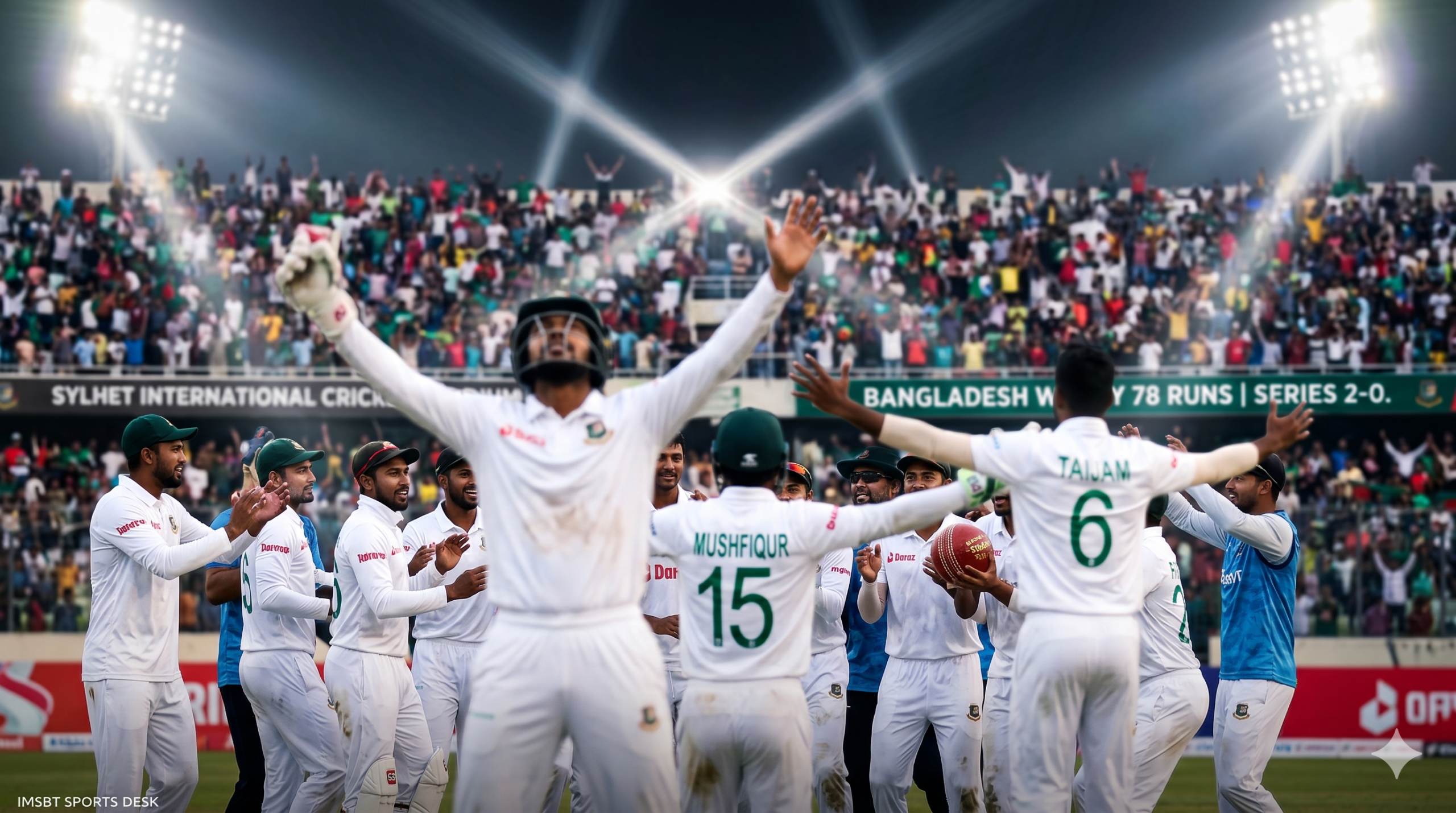
DHAKA — The paradigm of international red-ball cricket has shifted. In a sport where historical hierarchies often dictate long-term success, the Bangladesh national cricket team has officially shattered their historical glass ceiling. Following an authoritative and emotionally charged 78-run victory over Pakistan at the Sylhet International Cricket Stadium, the team affectionately known as the Tigers secured an unprecedented 2-0 series clean sweep.
The immediate fallout of this triumph reverberated far beyond the borders of the playing field. The International Cricket Council (ICC) officially updated its global Test team rankings matrix, confirming that Bangladesh has ascended to 7th place globally for the first time since gaining Test status in the year 2000. This monumental jump has seen them leapfrog established traditional powerhouses, including the West Indies and Pakistan themselves, signaling the dawn of a new, highly tactical era in Bangladeshi cricket infrastructure.
RANKING SHIFT: ICC TEST TEAM STANDINGS
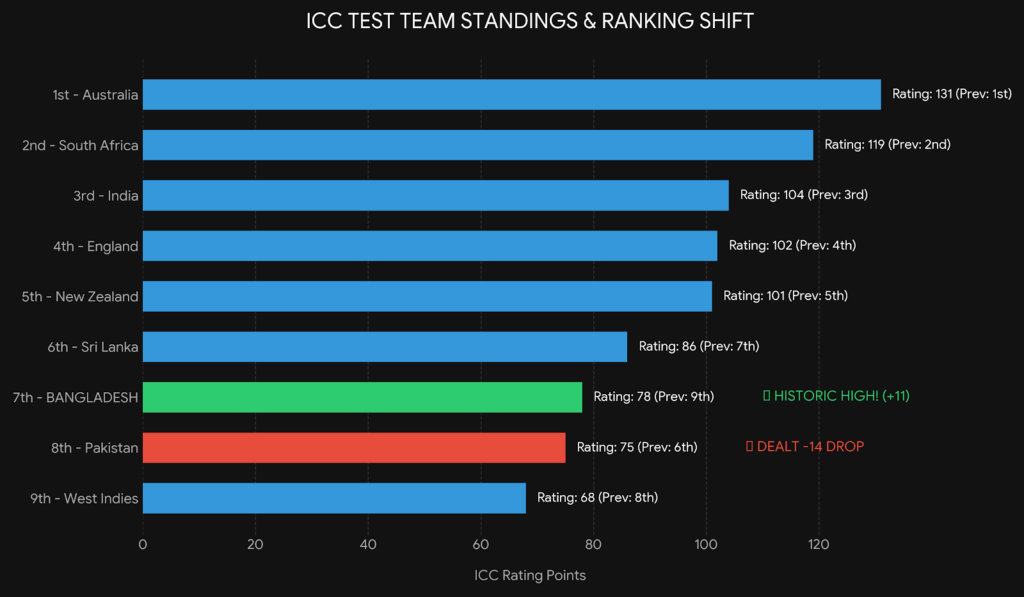
To truly comprehend the scale of this achievement, one must look closely at the mathematical volatile swings within the ICC rating calculator. Before the first ball was bowled at the Sher-e-Bangla National Cricket Stadium in Mirpur for the first Test, Pakistan sat comfortably at 6th in the world with 89 rating points, while Bangladesh languished at 9th with a meager 67 points.
The structural mechanics of a two-match series sweep provide a massive reward for low-ranked sides defeating teams above them. Over the course of the two dominant victories, Bangladesh gained a staggering 11 rating points, catapulting their team aggregate score to 78 points. Conversely, a devastated Pakistani side under the captaincy of Shan Masood bled 14 rating points, tumbling down to 8th place with a current baseline rating of 75.
Furthermore, this sweep acts as a vital booster engine for the ICC World Test Championship (WTC27) cycle. With 12 points awarded for an outright win, Bangladesh’s win-loss percentage has ballooned to 58.33%, pushing them up to an incredible 5th place globally on the WTC grid, successfully moving ahead of rival cricketing giants India and England.
Winning the toss proved secondary to structural discipline. Bangladesh took to the crease in the first innings and put together a sturdy foundation of 278 runs, anchored heavily by wicketkeeper-batsman Litton Das, who played a magnificent, counter-attacking knock of 126 runs off 159 deliveries. Das showcased meticulous control against the new ball, identifying horizontal scoring arcs and dispatching 16 boundaries along with 2 towering sixes to pull his team out of early situational trouble.
Pakistan’s response was immediately strangled by a multi-pronged bowling assault. Left-arm orthodox spinner Taijul Islam established an unplayable line and length, choking the scoring rate and picking up 3 wickets for 67 runs across his opening spells. Backed by raw pace from young prodigy Nahid Rana and line-precision from Taskin Ahmed, Bangladesh rolled Pakistan over for 232, securing a vital 46-run first-innings lead.
With a slim lead in hand, the second innings required standard, textbook Test match construction. Enter the legendary Mushfiqur Rahim. The veteran batsman executed an extraordinary innings of 137 runs, occupying the crease for over five hours and frustrating the Pakistani bowling attack. Rahim’s ability to manipulate single fields and rotate strike alongside a supporting 69 from Litton Das allowed Bangladesh to pile on a massive 390 runs before declaring.
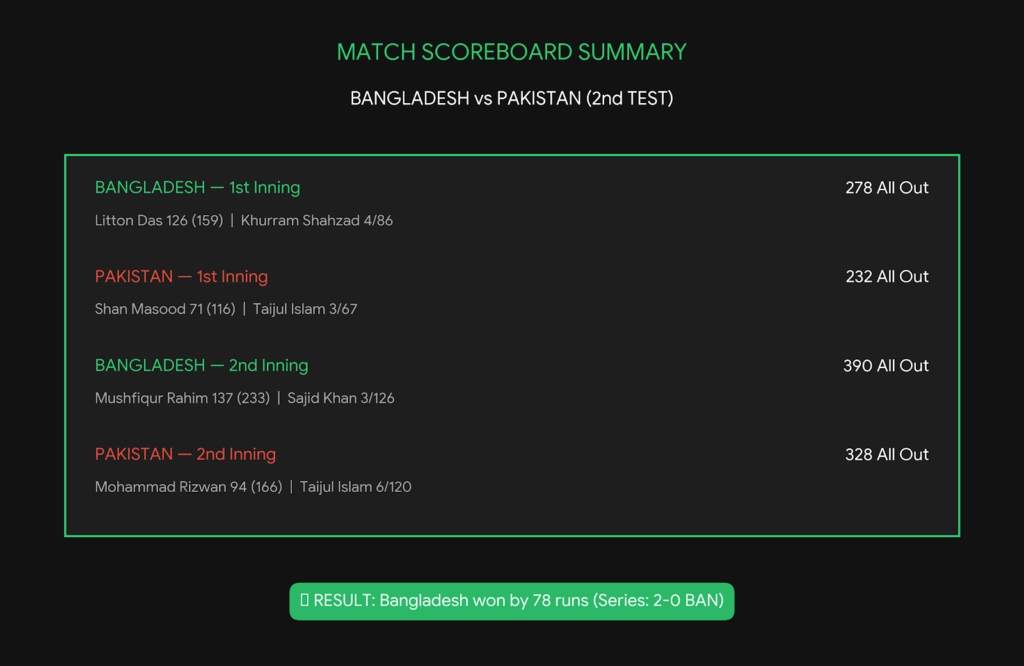
This monumental effort set Pakistan an improbable, record-shattering target of 437 runs in the final four sessions of the match.
The final day commenced with Pakistan sitting at a precarious 316-7, needing an additional 121 runs with only three lower-order wickets in hand. Despite the astronomical odds, Pakistani wicketkeeper Mohammad Rizwan threatened to stage a miraculous escape. Playing a lone, brilliant hand of 94 runs off 166 balls, Rizwan formed a gritty 54-run partnership with tailender Sajid Khan, punishing anything short and testing the tactical composure of the Bangladeshi fielders.
It was at this precise juncture that left-arm master craftsman Taijul Islam initiated his final, historic onslaught. Operating from the Academy End with a slightly scuffed ball, Taijul utilized subtle variations in arm speed and match-worn pitch crevices to completely disrupt the batsman’s footwork.
The Celebration: Taijul put the final exclamation point on the historic day, trapping Khurram Shahzad leg-before to finish with spectacular match-winning figures of 6 wickets for 120 runs in the second innings. The stadium erupted into pure euphoria as the Tigers clinched a 78-run win.
The Breakthrough: Taijul broke the frustrating 8th-wicket stand by teasing Sajid Khan (28) into an aggressive drive, inducing a sharp edge that flew straight into the waiting palms of slip cordon security. This marked Taijul’s 18th career five-wicket haul in Test history.
The Final Blows: Sensing blood in the water, captain Shanto re-introduced fast bowler Shoriful Islam, who immediately extracted sharp bounce to have a fatigued Rizwan caught on 94, completely ending Pakistan’s structural resistance.
What makes this 2026 series sweep extraordinarily significant is its continuity of historical dominance. For two decades, Bangladesh struggled with consistency in long-form, multi-day formats. However, this team has accomplished something that only elite world-class units have ever done before against Pakistan.
By following up their historic 2024 away Test series victory on Pakistani soil (where they secured a shocking 2-0 sweep in Rawalpindi) with an identical 2-0 sweep at home in 2026, Bangladesh has become only the second nation in cricket history—following the mighty Australian teams—to secure back-to-back Test series whitewashes against Pakistan.
This is no longer a case of an underdog capitalising on home-court advantage or lucky rain-interrupted pitches. It is an empirical demonstration of analytical supremacy. Bangladesh’s tactical team management has successfully weaponized deep bowling rosters and high-patience batting blueprints to transition from a brief limited-overs threat into a legitimate long-term red-ball titan.
With 1,551 total rating points locked safely into their account, Bangladesh sits comfortably clear of Pakistan (1,205 points) in 8th place. The immediate objective for the Bangladesh Cricket Board (BCB) and team management shifts directly toward sustaining this top-tier placement.
Directly above them in 6th place sits Sri Lanka with 86 rating points. The bridge to crossing into the global top six will require securing critical away victories during upcoming bilateral tours against heavy pace-friendly nations like Australia and South Africa.
The technical evolution of spinners like Taijul Islam, paired with the rapid velocity developments of young fast-bowling networks, ensures that Bangladesh possesses the tactical adaptability to compete on any surface globally. One thing remains entirely indisputable: the cricket world can no longer look at the Tigers as a developing nation. They are officially a top-tier powerhouse, and their historic 7th place ranking is a warning shot fired across the bow of the global elite.