Physical Address
304 North Cardinal St.
Dorchester Center, MA 02124
Physical Address
304 North Cardinal St.
Dorchester Center, MA 02124

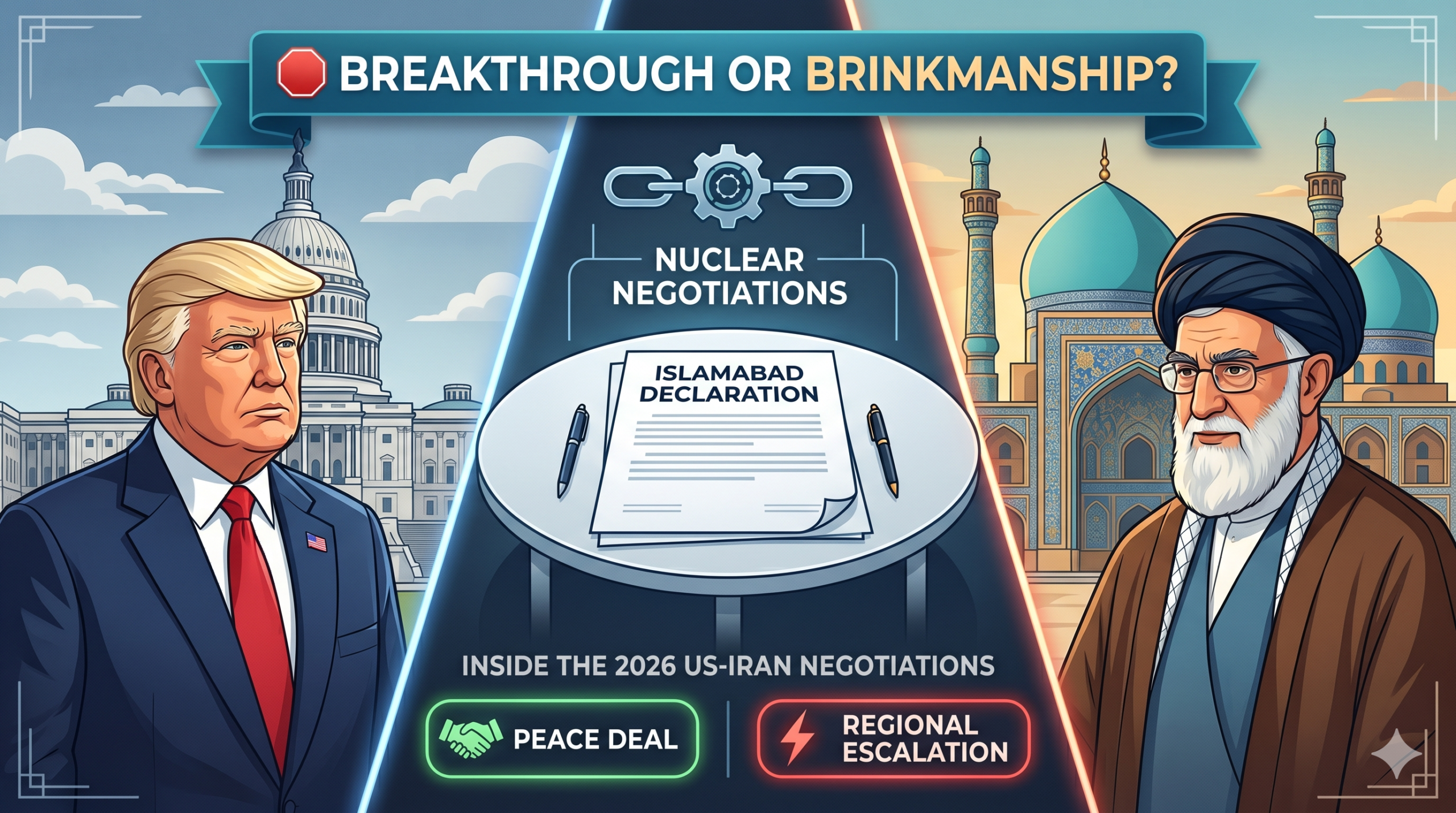
The international community is witnessing one of the most high-stakes diplomatic standoffs in modern history. Following six weeks of intense kinetic conflict, devastating air strikes, and a crippling maritime blockade, the United States and the Islamic Republic of Iran stand on the precipice of a definitive geopolitical crossroads.
President Donald Trump recently ignited global media spheres by confidently broadcasting that a prospective peace agreement has been “largely negotiated, subject to finalization”. Yet, underneath the veneer of diplomatic optimism lies a complex web of military leverage, unyielding strategic demands, and deep-seated systemic mistrust.
While public headlines oscillate between celebrating an imminent Middle East ceasefire and bracing for renewed military strikes, an analytical dive into the raw negotiation text reveals an entirely different story. The blueprint currently under review—frequently labeled the “Islamabad Declaration” due to its Pakistani mediation roots—presents a high-variance matrix where a single miscalculation could instantly plunge the global energy market into total chaos.
To cut through the narrative-driven media speculation and conflicting press releases coming out of Washington and Tehran, we must map out the hard structural parameters of the ongoing talks.
The table below outlines the core strategic pillars of the proposed 60-day Memorandum of Understanding (MOU) and the explicit points of friction separating the two superpowers:
| Strategic Metric Category | The United States Position (White House Blueprint) | The Iranian Regime Position (Tehran Counter-Proposal) |
| Nuclear Enrichment Baseline | Zero enrichment; full repatriation and removal of highly enriched uranium (HEU). | Complete retention of domestic HEU stockpile; absolute refusal to dismantle active centrifuges. |
| Maritime Transit Controls | Fully open, toll-free international navigation through the Strait of Hormuz; removal of naval mines. | Sovereign Iranian administrative control over the waterway; rejection of unilateral US maritime oversight. |
| Sanctions & Financial Relief | Phase-by-phase unfreezing of foreign assets conditional on verified NPT compliance metrics. | Immediate, front-loaded lifting of the port blockade and restoration of unrestricted crude oil export capabilities. |
| Regional Kinetic Scope | Comprehensive ceasefire encompassing the entire “Axis of Resistance,” including Lebanese Hezbollah. | Ending the war on all fronts, contingent upon the absolute withdrawal of US military leverage from the immediate warzone. |
The immediate engine driving the current diplomatic momentum is not a sudden change of heart regarding regional hegemony, but rather the severe economic pain radiating from the Strait of Hormuz. Following the US-imposed maritime blockade on Iranian ports, global oil markets have skirted dangerously close to an absolute breaking point.
Under the broad contours of the drafted 60-day ceasefire framework, the immediate tactical goals are highly pragmatic:
US Secretary of State Marco Rubio expressed cautious optimism regarding these maritime developments, stating that progress over a 48-hour sprint had laid the groundwork for a completely open strait. However, Rubio distinctly noted that the entire architecture “will require full Iranian acceptance and then compliance” to survive past its initial implementation phase.
While the maritime and economic components of the Islamabad Declaration offer a potential off-ramp for both economies, the actual US-Iran nuclear negotiations remain completely gridlocked. This is where public political rhetoric and hard technical realities violently collide.
[US CORE REQUIREMENT: "Zero Enrichment" + HEU Stockpile Removal]
                            VS.
[IRAN CORE REQUIREMENT: Retention of Nuclear Material as Sovereign Leverage]
President Trump has repeatedly claimed to his political base that Iran has fundamentally agreed to halt uranium enrichment and surrender its past nuclear materials. Yet, multiple high-ranking Iranian officials, speaking through state-linked outlets like Tasnim News Agency, have directly contradicted this claim. A senior Iranian diplomatic source explicitly stated to Reuters that Tehran has not agreed to hand over its highly enriched uranium (HEU) stockpile, asserting that the core nuclear issue is entirely excluded from the preliminary ceasefire agreement.
This systemic division was put on stark display at the conclusion of the 2026 Nuclear Non-Proliferation Treaty (NPT) Review Conference. The international event collapsed into a chaotic stalemate, failing to produce a consensus final document.
The US State Department issued a blistering critique following the conference, deeply regretting the “inability of some NPT States Parties to take Iran’s threat to global nonproliferation seriously,” pointing directly to Tehran’s ongoing disputes with the International Atomic Energy Agency (IAEA) and escalating enrichment activities that lack any credible civilian justification.
The volatility of these negotiations is further magnified by intense domestic political pressures inside both Washington and Tehran. Neither administration operates in a vacuum, and internal stakeholders are actively trying to dismantle the current framework.
Inside the United States, President Trump’s apparent willingness to entertain an agreement that allows nuclear material to remain inside Iranian borders has drawn sharp criticism from within his own party.
Republican Senator Thom Tillis publicly broke ranks during a recent CNN interview, expressing deep difficulty reconciling the administration’s previous wartime assertions that Iran’s military infrastructure had been comprehensively broken with the reality of the current soft diplomatic concessions. Conservative hawks fear that a temporary 60-day truce merely gives the Islamic Revolutionary Guard Corps (IRGC) space to regroup, rebuild its damaged air defenses, and secure financial lifelines without permanently neutralizing its breakout capacity.
On the opposite side of the table, Iran’s decision-making process is severely bogged down by acute security measures. Intelligence reports reviewed by US officials indicate that Iran’s Supreme Leader is currently operating from a highly restricted, undisclosed underground location with intentionally limited communication channels to prevent tracking or targeted strikes.
While senior Trump administration officials claim that the Supreme Leader has agreed to the broad, macroeconomic contours of the current draft deal, the physical and operational delays in getting paperwork signed through Mojtaba Khamenei and the Supreme National Security Council have slowed the diplomatic momentum to a crawl.
Meanwhile, hardline elements within the Iranian parliament are projecting absolute defiance, with national security spokesman Ebrahim Rezaei publicly mocking the diplomatic overtures, claiming that the United States is essentially “begging” to negotiate with the Islamic Republic from a position of profound strategic weakness.
When the analytical data settles, the 2026 US-Iran nuclear negotiations resemble a classic game of geopolitical chicken. President Trump himself has admitted that he remains split “50/50” between successfully executing a historic peace deal and completely walking away to restart high-intensity military strikes if Tehran exhibits any further signs of non-compliance.
                   [THE 2026 DECISION TREE]
                              │
         ┌────────────────────┴────────────────────┐
         ▼                                         ▼
[60-Day Ceasefire Signed]              [Diplomatic Talks Collapse]
         │                                         │
 ┌───────┴───────┐                         ┌───────┴───────┐
 ▼               ▼                         ▼               ▼
[Hormuz Opens]  [Nuclear Deadlock]   [Blockade Tightens]  [US/Israeli Strikes]
The 60-day framework outlined in the Islamabad Declaration is a brilliant tactical band-aid designed to temporarily cool down global oil markets, clear shipping lanes, and stop the immediate bleeding across regional fronts like Lebanon. But it deliberately kicks the most dangerous can down the road.
By completely omitting a definitive resolution to Iran’s highly enriched uranium stockpile and advanced centrifuge facilities, the preliminary agreement sets up an even more explosive confrontation two months down the line.
If Tehran utilizes the upcoming truce to quietly fortify its nuclear positions while pocketing front-loaded sanctions relief, the White House will face immense bipartisan pressure to terminate the agreement. For global investors, maritime shipping syndicates, and defense analysts, the final verdict remains clear: enjoy the brief diplomatic window, but keep your survival playbook wide open.