Physical Address
304 North Cardinal St.
Dorchester Center, MA 02124
Physical Address
304 North Cardinal St.
Dorchester Center, MA 02124

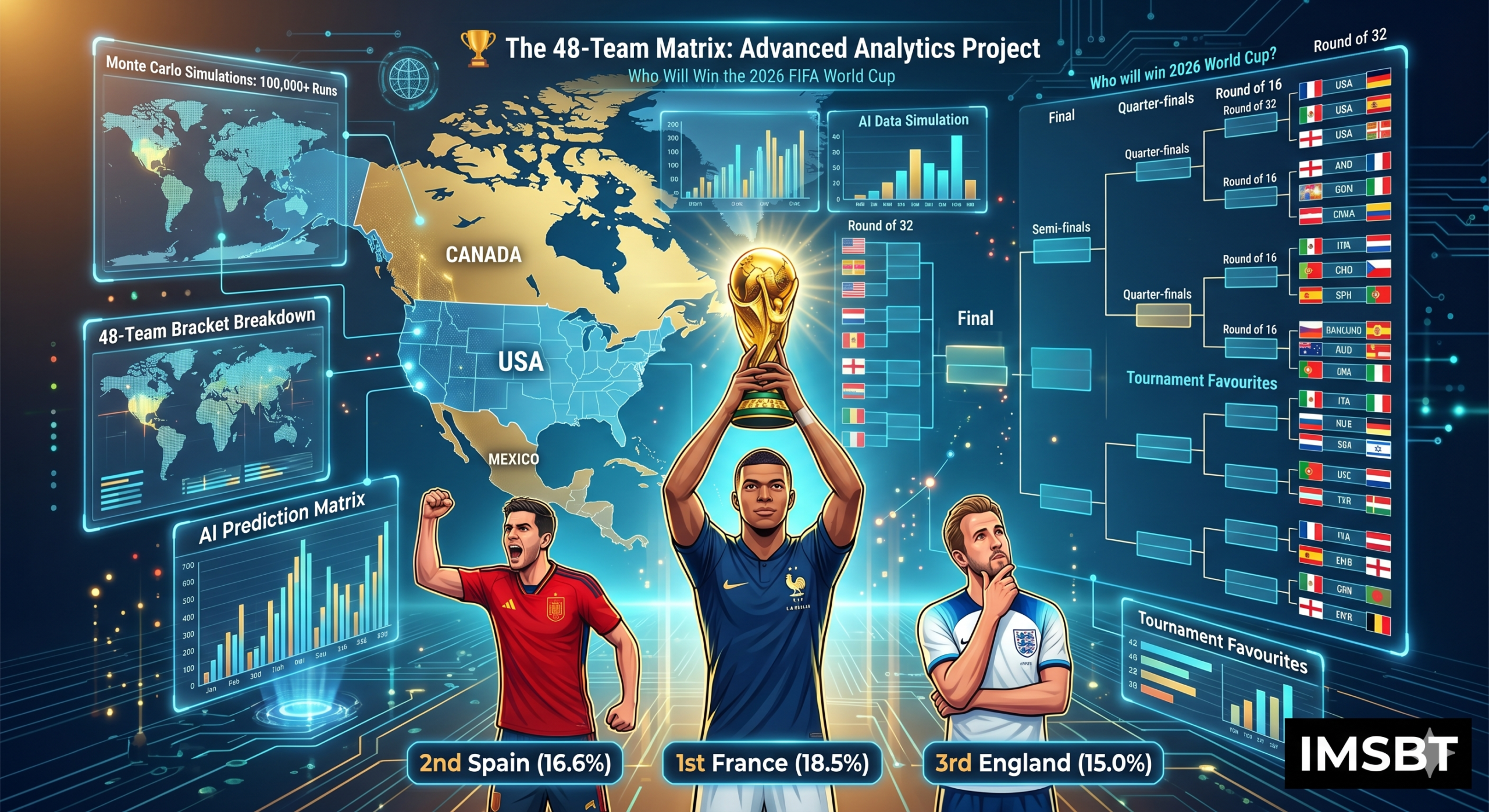
Every four years, international football grapples with its most ultimate query, prompting sports fans and legacy pundits alike to confidently broadcast their projections for global soccer supremacy. However, ahead of the historic tournament across the United States, Canada, and Mexico, the traditional analytical playbook has been completely rewritten. With the introduction of an unprecedented, expanded 48-team layout featuring 12 groups of four and an added Round of 32 knockout hurdle, the sheer variance of the tournament profile has exploded.
To slice through human bias and narrative-driven media speculation, modern sports networks have turned to deep algorithmic forecasting. Advanced soccer analytics platforms have fed deep-layered data—squad depth metrics, current technical form profiles, historical ELO strengths, and prospective bracket pathway combinations—into high-powered Monte Carlo simulator engines. Following over 100,000 distinct tournament simulations, a definitive hierarchy of world contenders has materialised, uncovering stark differences between raw sports book market odds and actual probabilistic reality.
SIMULATION MATRIX: PROBABILITY TO LIFT THE 2026 WORLD CUP
=========================================================
Rank   Nation          Implied AI Probability   Current Market Odds
---------------------------------------------------------
1st    France                 18.5%                   +450
2nd    Spain                  16.6%                   +450
3rd    England                15.0%                   +650
4th    Argentina              10.9%                   +900
5th    Brazil                 10.9%                   +800
6th    Portugal                8.2%                  +1000
7th    Germany                 7.6%                  +1400
8th    Netherlands             5.0%                  +2000
9th    Norway                  3.0%                  +3000
10th    Belgium                 2.3%                  +3500
=========================================================
Sitting firmly at the apex of the computational simulator runs is Didier Deschamps’ French national unit. While betting syndicates frequently alternate between France and Spain as the mathematical front-runners, the raw data shows that Les Bleus possess the most resilient squad profile for surviving an elongated knockout bracket.
The primary engine behind France’s dominant 18.5% simulation win-rate is their unparalleled depth across every functional zone on the pitch. In a tournament that now demands a gruelling eight matches to secure the trophy rather than the traditional seven, squad rotation and injury insulation become the ultimate sorting factors. France’s secondary unit boasts elite elite-level talent currently anchoring top-tier Champions League clubs, meaning tactical drops in quality are virtually non-existent.
Furthermore, Kylian Mbappé remains the most devastating match-winner in international football. When games breakdown into high-stress, low-possession knockout dynamics, tactical structures often matter less than raw, individual brilliance. France’s tactical design does not require total territorial dominance or excessive ball circulation; instead, they excel at choking spaces defensively and unleashing lightning-fast transition attacks. This highly pragmatic blueprint drastically minimizes high-risk errors over a multi-week tournament cycle.
Fresh off their absolute tactical masterclass on the continental stage, Luis de la Fuente’s Spanish side occupies the second slot in the predictive rankings. Spain’s analytical profile is built on an entirely opposite philosophy to France: sustained positional asphyxiation and total game rhythm management.
TACTICAL METRIC PROFILE: SPAIN vs FRANCE (AVERAGE SIMULATION)
=============================================================
Metric Category             Spain (La Roja)     France (Les Bleus)
-------------------------------------------------------------
Expected Field Tilt (Opp. Half)   68.2%               47.5%
PPDA (Passes Per Def. Action)      7.4                 11.2
Expected Goals from Open Play     2.14                1.89
Transition Vulnerability Index    High                Extremely Low
=============================================================
Spain’s 16.6% projection is heavily reinforced by their generational winger profile, led by the unstoppable Lamine Yamal. Unlike Spanish iterations of the past that controlled possession fruitlessly without lateral penetration, modern Spain couples midfield security with direct, high-velocity isolated duels on the flanks.
The simulator encounters its only major point of divergence here with real-world betting syndicates. The books often prize Spain as the distinct outright favorite due to public money volume, but the data engine slightly tones down their probability. The cause? High-pressing setups that rely on high defensive lines leave higher vulnerability scores to rapid counter-attacks in single-elimination scenarios, lowering their margin for error against low-block opponents.
The data completely isolates England from their historical baggage. While public narratives constantly debate the structural adjustments of the Three Lions, the algorithm looks strictly at personnel value—and on paper, England possesses a devastating starting eleven.
Led by veteran spearhead Harry Kane and backed by a world-class creative midfield engine room, England’s offensive output metrics sit in the top tier globally. The simulator positions England with a 15.0% chance of ending their infamous international trophy drought, showcasing that they possess a high implied baseline probability of reaching at least the semi-final stage in over 41.7% of all calculated bracket combinations.
The slight drag on England’s number comes down to structural defensive variables. When pressure situations peak and the simulation enters late-stage extra time and penalty shootout matrixes, England’s historic conversion metrics slightly diminish their efficiency rating compared to cold, clinical units like Germany or Argentina.
For generations, predicting tournament champions leaned heavily on selecting one of the two traditional South American titans based on prestige alone. According to modern data processing, that era has officially leveled out into a global crowd. Defending world champions Argentina and global icons Brazil sit tied at a 10.9% execution probability.
SOUTH AMERICAN CONTENDER RADAR
============================================================
ARGENTINA: 10.9% Outright Win Prob. | 34.5% Semi-Final Reach
Key Strength: Tactical Chemistry, Low Variance, Midfield Choke
------------------------------------------------------------
BRAZIL:    10.9% Outright Win Prob. | 35.7% Semi-Final Reach
Key Strength: Flank Velocity, Open-Play xG, High Peak Ceiling
============================================================
Argentina’s projection is anchored entirely on roster chemistry and a remarkably low tactical variance score. Under Lionel Scaloni, the squad has operated with a uniform, family-like cohesion since 2021, meaning they rarely beat themselves through lack of discipline or positional misunderstandings. Even with Lionel Messi operating in a highly managed, veteran capacity, their structural foundation remains remarkably difficult to crack.
Brazil, conversely, presents a highly volatile, high-ceiling profile. With Vinicius Junior spearheading an attack that can decimate any low block on earth, their peak performance capability is unmatched. However, tactical gaps in transition defense and historical inconsistencies in knockout matches against elite European units maintain their rating at a consolidated 10.9%.
Beyond the elite top five, the expanded 48-team matrix introduces massive opportunities for mathematical anomalies to disrupt the tournament grid.
Norway represents the ultimate tournament wildcard. While a 3.0% outright victory metric appears slim, their probability of causing a massive, bracket-shattering upset in the Round of 16 or Quarter-finals sits at a staggering 27.8%. Erling Haaland functions as a complete systemic cheat code; if Norway executes a deep defensive low-block and isolates Haaland against tired center-backs, they can eliminate a top-tier favorite without ever dominating possession.
Both of these European powers are flying quietly underneath the radar of main mainstream media hype. Portugal owns an incredibly dense, young roster that mimics France’s structural depth, while Julian Nagelsmann’s Germany features elite tactical flexibility. The simulation frequently drops both units into late-stage semi-final iterations, representing the absolute best value bets for fans looking away from the standard France-Spain duopoly.
When the data settles across 100,000 algorithmic calculations, the 2026 World Cup shapes up to be an intense war of attrition. The introduction of the Round of 32 means that a single bad night, a controversial red card, or a cold finishing spell will vanish a favorite instantly.
Because of this heightened chaos factor, France remains the most logical and safe analytical selection. Their system does not rely on emotional momentum or aesthetic perfection; they are a cold, calculated execution machine engineered specifically to win close, single-possession football matches when the stakes are at their highest. While Spain will capture the world’s imagination with beautiful football, the numbers indicate that Didier Deschamps’ depth will ultimately reign supreme in North America.